
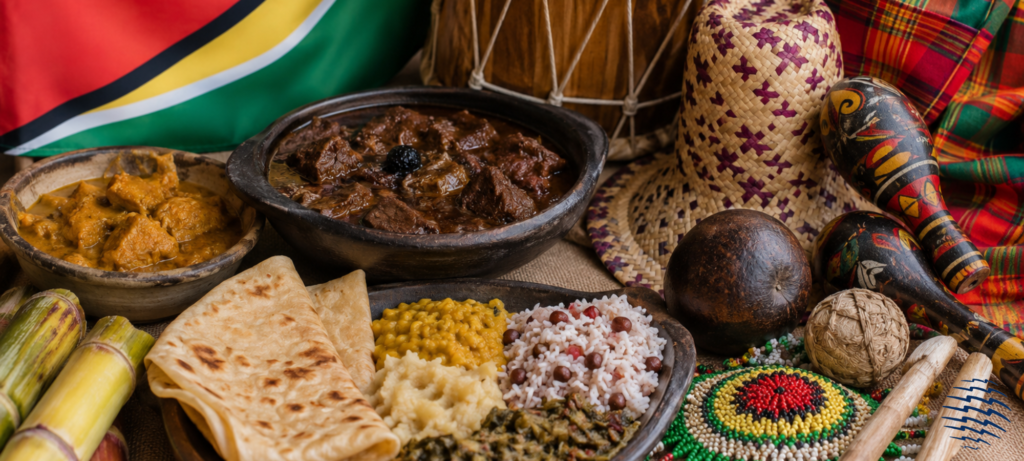
Ask ten Guyanese people to explain their own culture and you’ll get ten different answers. Somebody starts with Diwali lights strung up along a Georgetown street. Somebody else jumps straight to pepperpot on the stove Christmas morning. Somebody else won’t shut up about cricket. All of them are right, honestly. Guyanese culture isn’t really one tradition. It’s more like several traditions that ended up sharing the same small country and never bothered to fully separate again.
Guyana calls itself the Land of Six Peoples. Most national slogans are marketing fluff, but this one actually holds up. Indigenous nations, Africans, Indians, Chinese, Portuguese, and various European settlers all landed here and brought their own language, food, and beliefs with them. What came out the other end doesn’t look like any single piece of that. It just looks like Guyana.
Even the name means something. “Guyana” comes from an Indigenous word for “land of many waters,” which is basically a nod to all the rivers and drainage canals that quietly run the show here, deciding where people can build, farm, or even just walk without flooding.
Geographically, that puts Guyana on the South American mainland. Culturally, though? Not really South American at all. English is the official language. Cricket is close to a religion. And the festival calendar bounces between celebrations that share nothing on paper, yet somehow the whole country turns up for every single one. This guide gets into where all that comes from, the people, the food, the festivals, the language, the folklore, and the smaller everyday habits nobody writes tourist brochures about but that shape life here just as much.
Where Guyanese Culture Comes From: The Land of Six Peoples
The official motto is “One People, One Nation, One Destiny.” Nobody really says that out loud, though. What you’ll actually hear is the Land of Six Peoples, shorthand for the groups that make up Guyana today: Indigenous (Amerindian) communities, Afro-Guyanese, Indo-Guyanese, Chinese-Guyanese, Portuguese-Guyanese, and everyone else of mixed or other European background.
None of these groups stayed neatly separate for long. Each one showed up with its own religion, cooking style, and customs, and over a few generations those threads got tangled together into something new. You can see it clearest on the festival calendar, where Hindu, Christian, Muslim, and Indigenous celebrations don’t get treated as “someone else’s holiday.” They’re just national events at this point.
Indigenous peoples were here first. Long before anyone else showed up. There are several distinct nations under that umbrella, including the Wapishana, Macushi, Arawak, and Warrau, and plenty still live across Guyana’s interior today, keeping their own languages and craft traditions alive. Their fingerprints are on the food too, more than most people realize. Cassava. Pepperpot. Both go back to Indigenous cooking, long before anyone else turned up on the coast.
Afro-Guyanese communities descend from Africans who were enslaved and brought to the colony during the plantation years. Their influence runs through the music, the food, the religious life, basically everything, and it’s a big part of why August 1st, Emancipation Day, means so much on the national calendar. Cuffy, who led a major uprising against slavery back in 1763, is still one of the country’s most recognized historical figures. There’s a monument to him in Georgetown.
Indo-Guyanese communities mostly trace back to Indian indentured labourers brought over in the 19th and early 20th centuries, after slavery had already ended. Hindu and Muslim customs from this community show up everywhere. Festivals. Everyday cooking. How a lot of families are structured.
Chinese-Guyanese and Portuguese-Guyanese communities arrived in smaller waves during the 1800s, part indentured migration, part free migration. Both groups are a smaller slice of the population these days, but you’ll still spot them in the food, in certain family names, and in parts of Guyana’s business world.
Religion in Guyana: A Working Mix
Religion is probably the fastest way to see how mixed Guyanese culture actually is. Christianity, Hinduism, and Islam are all widely practiced, and out in the interior, Indigenous spiritual traditions never really went away either. What’s genuinely unusual isn’t the diversity itself. It’s how normal it feels on the ground.
Folk beliefs with African, Amerindian, and Indian roots have quietly worked their way into how all three major religions actually get practiced day to day, rather than staying off to the side. It’s completely normal for Guyanese of different faiths to show up at each other’s celebrations. Public holidays reflect that too. Christmas and Easter sit right next to Diwali and Eid-ul-Fitr, and none of them gets treated as more official than the rest.
Guyanese Festivals and National Celebrations
If you want to actually feel Guyanese culture instead of just reading about it, the festival calendar is where you go. Nearly every big celebration turns into a shared national event, not something one community celebrates while everyone else just watches.
Mashramani, held every February 23rd, marks the anniversary of Guyana becoming a republic. The name comes from an Indigenous word roughly meaning “celebration of work,” and honestly the day lives up to it: costume bands, calypso and soca competitions, street parades, food stalls stretching for blocks. It feels a bit like Trinidad’s Carnival, but with its own distinctly Guyanese flavour.
Diwali, the Hindu festival of lights, brings out huge public motorcades with illuminated floats rolling through Georgetown. Not many festivals show as clearly how something rooted in one community, Indo-Guyanese religious tradition in this case, ended up belonging to the whole country.
Phagwah, also called Holi, means coloured powder, water, music, and crowds from every background, not just the Hindu community it started with.
Eid-ul-Fitr and Eid-ul-Adha are two of the biggest days for Guyana’s Muslim community. Prayer, family gatherings, shared meals, and the wider public tends to take note as well.
Emancipation Day, on August 1st, marks the end of slavery across the British Caribbean and carries real weight for Afro-Guyanese communities specifically. Cultural displays, traditional dress, drumming, all central to how it’s marked.
Independence Day, on May 26th, marks the break from British colonial rule back in 1966. Flag-raising, parades, the usual mix of ceremony and celebration.
Christmas mixes old British tradition with a very local rhythm. Houses get scrubbed and repainted before the day arrives, and dishes like garlic pork, pepperpot, and black cake take over the table, no matter what a family’s religious background actually is. Black cake alone can start weeks or months ahead, since the dried fruit needs real time soaking in rum or wine to build up flavour.
What Guyanese People Eat: Food as Cultural Identity
Guyanese food tells basically the same layered story as everything else here. African, Indian, Indigenous, Chinese, and European cooking all end up on the same table, sometimes in the exact same dish.
Pepperpot sits at the centre of it all. A slow-cooked meat stew flavoured with cassareep, a bitter extract made from cassava. It’s got Indigenous and Afro-Guyanese roots, and it shows up on most Christmas tables across the country. From there you’ve got roti and curry, dhal and rice, and metagee (sometimes spelled metemgee, a one-pot dish of ground provisions cooked in coconut milk with dumplings called duff), all reflecting that strong Indo-Guyanese and Afro-Guyanese influence on everyday cooking. Chinese-Guyanese food has left its own mark too. Chow mein and fried rice aren’t treated as foreign anymore. They’re just comfort food now.
Cook-up rice, a mix of rice, beans or peas, meat, and coconut milk, has made its way into pretty much every household’s rotation regardless of background. Along the coast, crab soup made with okra pops up as well, and honestly it’s close enough to Louisiana gumbo that the resemblance is hard to miss.
Homemade drinks matter just as much as the food. Mauby, brewed from tree bark. Sorrel, made from hibiscus. Ginger beer. Peanut punch. All common, alongside simpler stuff like lime wash and fresh pineapple drink. Ginger beer especially becomes the go-to Christmas drink in a lot of households, filling roughly the same role eggnog plays further north. Ground provisions like cassava, sweet potato, and eddoes sit underneath a lot of this cooking too, showing up across nearly every community’s kitchen in one form or another.
If you want the full breakdown of Guyanese culture food and where each dish actually comes from, our guide to Guyana food and recipes goes a lot deeper than what fits here.
Language: English, Creolese, and Everyday Slang
Guyana’s the only English-speaking country on mainland South America, and that’s a big reason the culture leans so hard toward the Caribbean instead of its Spanish- and Portuguese-speaking neighbours.
Standard English is really just the surface, though. Most Guyanese also speak or at least understand Guyanese Creolese, an English-based creole with its own grammar and rhythm shaped by that same African, Indian, Indigenous, and European mix that runs through everything else in this guide. Everyday conversation leans heavily on local slang, the kind outsiders usually find charming and sometimes impossible to follow. Our full breakdown of Guyanese slang words and phrases covers the common greetings and expressions in more depth than there’s room for here.
Indigenous languages like Wapishana, Macushi, and Arawak are still spoken in parts of the interior too, even though English and Creolese dominate along the coast, where most Guyanese actually live.
Guyanese Folklore: Old Higue, Obeah, and Cumfa
This part of Guyanese culture gets way less attention than the food or the festivals, but it might be the most interesting bit of all. Guyanese folklore mixes African, Indigenous, Indian, and European beliefs into stories that are still alive in rural communities, even if younger generations mostly treat them as spooky stories now instead of literal warnings.
The Old Higue is the one most people know. An old woman who sheds her skin at night, turns into a ball of fire, and goes looking for a baby’s blood. According to the story, a family that suspects one is nearby leaves a pile of uncooked rice by the door, because she’s compelled to stop and count every single grain. That buys enough time to catch her before sunrise, supposedly.
Obeah is a spiritual practice rooted in West African tradition, carried over from the days of slavery. It’s about petitioning ancestors for help with health, family, work, protection, that kind of thing, and it still carries real cultural weight in parts of Guyana alongside the country’s mainstream religions.
Cumfa is a ceremonial dance built around drumming meant to call spirits into a dancer’s body. It’s intense to watch. Performers are said to dance over broken glass or handle fire without getting hurt while the spirit is supposedly present.
None of this is unique to Guyana. Similar beliefs show up all over the Caribbean. What feels distinctly local is how they’ve folded into everyday Guyanese life alongside Christianity, Hinduism, and Islam instead of staying separate from them.
Music, Literature, and the Arts
Guyanese music draws from the same wide pool as everything else in this guide. Chutney music and Indian classical influences sit right next to calypso, soca, and reggae, genres shared broadly across the English-speaking Caribbean. Drumming, especially in Afro-Guyanese communities, sits at the centre of both cultural and religious life, front and centre during Emancipation Day and Cumfa ceremonies alike.
There’s a genuinely strong literary tradition here too, more than people expect. Edgar Mittelholzer is generally seen as the country’s first major novelist, debuting with Corentyne Thunder in 1941 before writing over twenty more books after that. Wilson Harris leaned heavily on Amerindian myth and the mood of Guyana’s rainforest interior throughout his work. Poet Martin Carter is still widely read, shaped by the political upheaval of the 1940s and 1950s. On the visual side, painter Aubrey Williams built most of his career around Indigenous motifs, while sculptor Philip Moore drew from West African artistic traditions. Both are still considered among the country’s most important artists.
Bollywood has its own loyal following here as well, particularly within the Indo-Guyanese community. Strong enough that visiting Indian film stars have occasionally gotten honorary recognition in Georgetown.
Traditional Dress and Everyday Style
Most Guyanese dress like people anywhere else on a normal day. But traditional clothing still matters a lot around festivals and religious events. Indo-Guyanese traditional wear, saris and kurtas especially, comes out in full force during Diwali and Phagwah. Afro-Guyanese traditional dress, often bright African-inspired prints paired with headwraps, takes over during Emancipation Day.
Colonial Architecture and How Guyanese Homes Are Built
Older buildings around Georgetown still carry a heavy British colonial influence: wooden houses with high ceilings, jalousie windows, wraparound verandas, all built for ventilation back before air conditioning existed. In rural areas, homes commonly sit on stilts, a practical answer to flooding, since a lot of Guyana’s coastal belt actually sits below sea level and depends on drainage canals first built during the Dutch colonial period. Small detail, but it says a lot. Even the buildings answer to the water this country is named after.
Cricket and the Role of Sport in Guyanese Culture
Honestly, you can’t really talk about Guyanese culture without landing on cricket eventually. As part of the wider West Indies cricketing world, Guyana has turned out plenty of internationally known players, and the sport carries meaning here that goes way past entertainment. British military teams introduced the game originally, but over time it became one of the few spaces where non-white Guyanese could earn genuine recognition during the colonial era, and that history still shapes how deep cricket runs in national identity. The West Indies’ 1950 win over England at Lord’s is still remembered as one of the proudest moments in the region’s cricketing history. It even got its own calypso song at the time.
Providence Stadium, built for the 2007 Cricket World Cup, is still a point of local pride, and it’s hosted a few memorable moments since, including a rare four-wickets-in-four-balls performance during the tournament’s opening matches.
Whether it’s a neighbourhood match or the West Indies playing internationally, cricket pulls people together in a way not much else manages, no matter someone’s background. Football, athletics, and basketball are picking up followings too, but cricket’s still the sport that feels tied to being Guyanese.
Family, Community, and Everyday Values
Family sits at the centre of life here. That usually means the extended family, grandparents, aunts, uncles, cousins, staying actively involved rather than just showing up for holidays. Multiple generations often live close together, sometimes under one roof, and respect for elders isn’t just something people talk about. It’s baked into daily language. That’s why words like “Auntie” and “Uncle” get used for basically any respected older person, blood relative or not, from childhood on.
Communities tend to stay close outside Georgetown especially. People know their neighbours, and things like religious festivals, cricket matches, or a family celebration tend to pull in the whole street, not just the immediate family. Even grief gets handled communally. A traditional Guyanese wake brings neighbours and extended family together to support a grieving household, who in turn usually provide food for everyone who comes to sit with them.
Everyday Customs Worth Knowing
Beyond the big festivals, there’s a whole layer of Guyanese culture and customs that only really shows up once you’ve actually spent time there. Small habits nobody writes about but that shape how people interact day to day.
- Hospitality runs deep. Visit someone’s home and you’ll probably get offered food or a drink almost immediately. Turning it down flat can come across as a little rude. Accepting something small is the polite move.
- Greetings actually matter. Walk past someone without a “good morning” or a nod, especially in smaller communities, and people notice. It ties right back to that respect-for-elders thing mentioned above.
- Sunday is still a family day in a lot of households, regardless of religion, usually built around a big family lunch that cuts across Guyana’s different communities rather than belonging to just one.
- Punctuality is loose in casual settings but tightens up fast for anything formal, weddings, funerals, business meetings, where showing up on time genuinely matters.
- Gift-giving during festivals is just normal, whether that’s sweets at Diwali, shared food at Christmas, or small tokens during Eid. It’s less about the value and more about the gesture, which honestly sums up Guyanese culture and traditions pretty well.
Frequently Asked Questions
What is Guyanese culture?
Guyanese culture is the shared identity of Guyana’s people, shaped by Indigenous, African, Indian, Chinese, Portuguese, and European heritage. It shows up in festivals, food, language, religion, folklore, music, and family life, and it’s usually summed up through the country’s Land of Six Peoples identity.
What are the main traditions in Guyanese culture?
The big ones centre on festivals like Mashramani, Diwali, Phagwah, Eid, Christmas, and Emancipation Day, plus strong food traditions, close extended families, folklore like the Old Higue and Obeah, and a national love of cricket.
What food is part of Guyanese culture?
Core dishes include pepperpot, roti and curry, dhal and rice, cook-up rice, metagee, and Chinese-Guyanese staples like chow mein, all reflecting the country’s mixed heritage.
How does Afro-Guyanese culture influence the country?
Afro-Guyanese culture has shaped Guyana’s music, especially drumming traditions, its food, folklore practices like Obeah and Cumfa, and observances like Emancipation Day, which marks the end of slavery in the British Caribbean.
Is Guyana part of the Caribbean or South America?
Geographically it’s South America, no question. Culturally, though, it identifies far more with the Caribbean. It’s the only English-speaking country on the continent, shares festivals and food with Caribbean neighbours, and plays cricket as part of the West Indies rather than joining any South American sporting culture.
What language do Guyanese people speak?
English is the official language, but day to day, most Guyanese speak Guyanese Creolese, an English-based creole with its own grammar and vocabulary shaped by the country’s African, Indian, Indigenous, and European influences.
The Bigger Picture
Guyanese culture was never built as one single tradition to begin with. It’s several distinct heritages that ended up sharing the same small country for generations and, somewhere along the way, built something genuinely new together. That’s really what makes it worth understanding beyond a list of facts. The festivals, the food, the language, the folklore, and the family values covered here aren’t separate traditions just sitting side by side. They’re part of one national identity that Guyanese people live out constantly, whether that’s at a Diwali motorcade, a Mashramani parade, or just around the table for Sunday lunch.
For a broader look at the country beyond culture alone, Encyclopaedia Britannica’s entry on Guyana and the official Guyana Tourism Authority’s culture page are both worth a look too.