
Guyana wildlife is shaped by one simple fact: most of the country’s interior has never had a road through it. Rivers do the job highways do elsewhere, and between them sit forests that run for hundreds of kilometres without a town. Animals that have disappeared from much of South America still have room to roam here.
This guide covers what lives in the country and why. We’ll also look at where people go to see it, which animals need some caution, who protects them, and what you can realistically expect on a trip. One thing upfront: seeing a jaguar is much harder than most travel brochures suggest.
Why Guyana Wildlife Is So Diverse
Guyana sits on the Guiana Shield, an ancient block of rock that runs under parts of Venezuela, Brazil, Suriname, French Guiana and Colombia. The forest growing on top of it is among the least disturbed tropical forest left anywhere. Forest covers more than 80 percent of the country, and most of its fewer than a million people live along the Atlantic coast.
That makes the interior very quiet. There are few large towns and little big-scale farming. Hunting does still happen in some rural and Indigenous communities, but the forest itself stays largely intact.
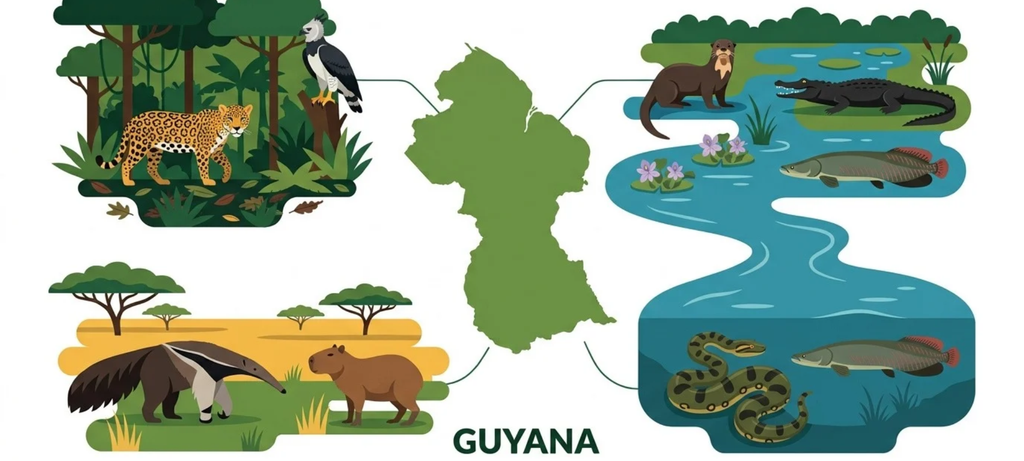
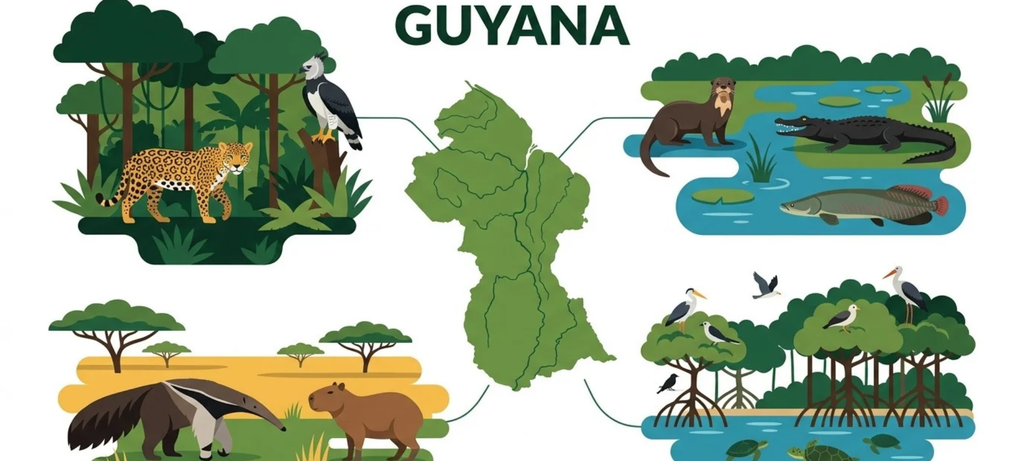
The second reason is variety. In one small country you get lowland rainforest, white-water and black-water rivers, flooded forest, open savannah in the south-west, sandstone mountains, mangroves and nesting beaches. Each habitat holds its own set of animals. That variety is what makes wildlife in Guyana so rewarding to explore.
Published totals differ by source and keep changing as surveys continue. The usual figures are more than 800 bird species and over 225 mammals, plus hundreds of reptiles, amphibians and freshwater fish. Treat these as ballpark numbers, not exact counts.
For anyone curious about the wildlife of Guyana, this mix is the thing to grasp. Very few places let you watch a giant anteater cross open grassland on Monday and hear howler monkeys in the canopy on Wednesday.
The Most Iconic Wildlife in Guyana
Jaguar
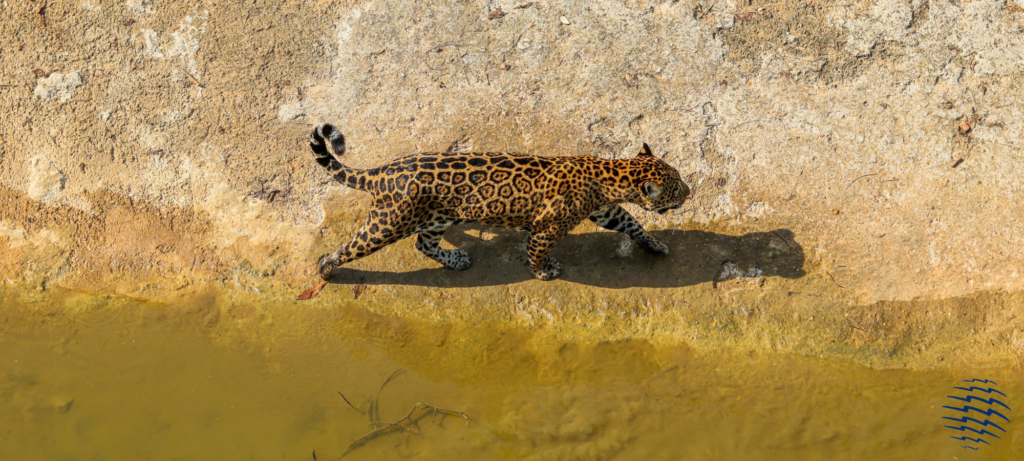
The jaguar is the Guyana national animal, and it appears on the national coat of arms. It’s also the animal people ask about most and see least. Jaguars live alone, hunt mostly at dawn, dusk and night, and cover huge territories. They avoid people. Even guides who work in the forest every week can go months without a clear sighting.
That rarity is part of why the cat matters. A healthy jaguar population needs plenty of prey and large areas of connected forest. So a fresh track on a river sandbank tells you something about the whole ecosystem. Iwokrama and the Rupununi have the best reputation for Guyana wildlife sightings of this cat. Most of the time, a good guide will point out a footprint before an actual animal.
Giant River Otter
Giant otters can reach about 1.7 metres and live in family groups of eight or ten. They’re loud. A group announces itself with whistles, barks and splashing long before you see it, and the noise gets worse if you drift too close to their den.
They stick to clear, fish-rich waterways and are listed as endangered. Habitat loss, mercury from gold mining and old fur hunting all pushed their numbers down across the continent. Guyana’s remote rivers are now one of the more reliable places to meet them, and seeing them there is a useful sign of a functioning aquatic ecosystem.
Giant Anteater
If the jaguar belongs to the forest, the giant anteater belongs to the Rupununi grasslands. It’s easy to spot in the open, since a two-metre animal with a flag-like tail has nowhere to hide. Look for a slow, swaying walk across the savannah in early morning or late afternoon, with the snout working at a termite mound.
Anteaters have almost no teeth. They tear a mound open with their claws and use a tongue much longer than you’d expect. Those claws are also a real defence, and a cornered anteater can hurt a predator.
Harpy Eagle
Few birds have this kind of presence. The harpy eagle is one of the largest eagles in the world, and it hunts monkeys and sloths in the canopy. It needs big, mature trees to nest in, and a pair raises just one chick every two years or so.
Because it breeds slowly and needs old forest, the harpy eagle is a good sign of healthy habitat. Sightings aren’t guaranteed, but local guides know nest sites in places like the Kanuku Mountains and the forests around Iwokrama. If birds are your main interest, our guide to the birds of Guyana covers the national bird, the hoatzin, along with macaws, cock-of-the-rock and plenty more.
Black Caiman
The black caiman is the largest predator in the Amazon basin. Adults can reach around four to five metres, although most are considerably smaller. Heavy hunting for its skin nearly wiped it out in the twentieth century. Numbers have recovered in several Guyanese rivers, and night boat trips with a spotlight are now a classic Rupununi experience. At first all you see is a pair of red-orange eyes shining back from the water.
Green Anaconda
Green anacondas like swamps, flooded forest and slow channels. They lie almost completely underwater with just their eyes and nostrils showing. They’re the heaviest snakes in the world, and big females are far larger than males. Most stories about them eating people are exaggerations. In reality they’re shy, and the usual sighting is a thick coil half hidden in water plants.
Arapaima
The arapaima is a scaled freshwater fish that can grow past three metres. Its odd trick is breathing air. Besides gills, it has a modified swim bladder that works like a lung, so it has to come up to the surface regularly. That habit made it easy to harpoon, and arapaima numbers dropped across much of the Amazon basin.
The Rupununi story went differently. Local communities started managing the fishery themselves. They count fish, set quotas and protect nursery lakes, and numbers have held up better than in many neighbouring areas. It’s one of the best-known community conservation successes in the country.
Capybara
Capybaras are the largest rodents in the world, and they’re very social. You’ll often see a dozen grazing together at the water’s edge, with the young ones tucked close to the adults. They rarely wander far from water because that’s how they escape predators. Their eyes, ears and nostrils sit high on the head, so they can float with most of the body hidden.
Other Notable Species
The list keeps going. Giant armadillos dig burrows in the savannah and forest edge, though you’ll rarely see one. Lowland tapirs move through the forest at night. Red howler monkeys wake the forest at dawn with a roar that carries for kilometres. Toucans, scarlet macaws and several species of parrot are common sights in the right habitats. Sloths hang in the cecropia trees, and poison dart frogs sit in the leaf litter. The tiny golden rocket frog lives in the bromeliads around Kaieteur Falls and has a very small range.
The Habitats That Shape Guyana’s Wildlife
Rainforest. Guyana rainforest wildlife is layered. Monkeys, macaws, toucans and the harpy eagle use the canopy, while tapirs, agoutis and jaguars stay on the forest floor. Animals in Guyana’s rainforest are mostly shy and well camouflaged, so you’ll hear far more than you see. Patience matters more than a long camera lens.
Rivers and wetlands. Rivers are the roads of the interior and home to much of the country’s biggest wildlife. Giant otters, arapaima, black caiman, anacondas and capybaras all depend on water. In the wet season the rivers spill into the forest and fish swim between the tree trunks, which changes where everything else feeds.
Rupununi savannah. The south-west is dry grassland broken up by termite mounds, low hills and strips of forest along the creeks. Open ground means more visible animals. Giant anteaters, capybaras, burrowing owls and savannah hawks are all possible, and the Kanuku Mountains rise in the background.
Coast and mangroves. The Atlantic coast is muddy and shallow, with mangroves and huge numbers of shorebirds. Further along, Shell Beach is a long stretch of sand where four species of marine turtle come ashore to nest.
Where to See Wildlife in Guyana
Iwokrama Forest. This large protected forest in central Guyana is managed for conservation and research as well as tourism. It has a canopy walkway, river trips and a solid record for jaguar and bird sightings. For most people it’s the best all-round starting point.
Rupununi. Savannah drives, night caiman trips and community lodges make this the best region for giant anteaters and open-country birds. The villages here are used to guiding visitors.
Kaieteur National Park. Most people come for the 226-metre waterfall on the Potaro River, but the park around it deserves attention too. Look for golden rocket frogs in the bromeliads and Guianan cock-of-the-rock near the trails. Our guide to tours to Kaieteur Falls explains how most people get there, and flying in is the usual route.
Kanuku Mountains. Remote and rarely visited, this range is known for birds, primates and large mammals. It suits people who’ll accept basic conditions in exchange for real wilderness.
Shell Beach. Leatherback, green, hawksbill and olive ridley turtles nest here, with the main season running roughly from March to August. Confirm the timing with local conservation groups before you plan a trip.
Rewa. Rewa Guyana is a small Makushi community on the Rupununi River that runs its own eco-lodge. Visitors paddle for giant otters, fish for piranha and look for arapaima, with villagers as guides. Tourism income stays in the community, which is the whole idea.
Dangerous Animals in Guyana: What Visitors Should Know
People ask about dangerous animals in Guyana all the time, so here’s the straight answer. Yes, some can hurt you. But serious incidents are rare, and the daily risks are much smaller than most people imagine.
Jaguars generally avoid people, and attacks are extremely uncommon. Black caimans and anacondas are wary too. Venomous snakes such as the fer-de-lance (called labaria locally), the bushmaster and coral snakes live in the forest. The usual advice is simple: watch where you put your hands and feet, and wear boots on trails. Piranhas look scary but rarely cause trouble. Stingrays in shallow river sand, electric eels, bullet ants and spiders deserve respect, and guides know how to handle all of them.
The more realistic hazard is the mosquito. Malaria and dengue can occur in parts of the interior, so check current travel-health advice with a clinic before you go, and pack repellent. Heat, dehydration and slippery trails cause more problems than any predator.
What about dangerous wildlife in Georgetown, Guyana? Very little. The capital is a city, not a jungle. You might see a caiman in a drainage canal, a snake after heavy rain, and plenty of mosquitoes at dusk. The Botanical Gardens are known for their manatees, which are harmless.
On plants, the practical hazards are thorny palms, nettle-type plants and irritating sap. That’s why long sleeves are standard in the forest. Your guide will tell you what to avoid.
Wildlife Conservation in Guyana
Guyana wildlife conservation relies on a mix of government agencies, protected areas, research groups and local communities. The forest is largely intact, but pressure is growing. Gold mining pollutes rivers with mercury and clears land. Illegal wildlife trade, hunting and new infrastructure add more strain. Climate change affects rainfall and river levels, which in turn affects breeding for turtles, fish and birds.
The main government body is the Guyana Wildlife Conservation and Management Commission (GWCMC), sometimes called the Guyana Wildlife Commission. It’s responsible for wildlife management and regulation, including permits and controls on wildlife use and trade. It also runs the Guyana Zoological Park and Wildlife Rescue Center in Georgetown, which cares for confiscated and injured animals. The Protected Areas Commission looks after national parks like Kaieteur, and Iwokrama operates under its own mandate.
Community conservation is where Guyana has done some of its most interesting work. Rewa, the arapaima scheme and turtle monitoring at Shell Beach all show what happens when the people living near animals benefit from protecting them. For the wider regional picture, WWF Guianas shares its work across the Guiana Shield, and the official Guyana Tourism nature and wildlife page shows what the government promotes for visitors.
Can You Take Wildlife Tours in Guyana?
Yes, and there’s more choice than most people expect. Guyana wildlife tours usually fall into a few types: rainforest lodge stays, river trips with night spotlighting, birdwatching, guided jungle walks, savannah drives and community stays like Rewa. Some trips are built for photographers and serious birders, with specialist guides.
One thing to know first: wildlife watching here isn’t like an African safari. Much of it happens from boats, forest trails, observation towers and small vehicles on savannah tracks.
Many Guyana wildlife holidays link several regions, such as Georgetown, Kaieteur, Iwokrama and the Rupununi, over one to two weeks. The interior is costly to reach because many lodges need small aircraft or long river journeys, so budget carefully. Pick operators who hire local guides and keep a respectful distance from animals.
Timing matters too. Guyana has two wet and two dry seasons. The main wet period runs roughly from May to mid-August, with a shorter one around December and January. The drier stretches, roughly February to April and September to November, usually make Rupununi travel easier. Kaieteur Falls looks most powerful after rain. Seasons shift from year to year, so check with your operator.
What Wildlife Are You Actually Likely to See?
Let’s be honest about this. You’ll almost certainly see lots of birds, even on a short trip: parrots, macaws, toucans, hawks and kingfishers. Monkeys such as howlers and capuchins are common. So are caimans on night boat trips, capybaras at the waterside and plenty of frogs, lizards and insects.
Harder sightings include giant river otters (a good chance on the right river, but no promises), giant anteaters (reasonable in the Rupununi), harpy eagles (you need a known nest and some luck) and giant armadillos (very rare). Jaguars are the long shot. Some people spend a week in jaguar country and find only tracks. Anyone who promises you a sighting is overselling.
Why Guyana Stands Out as a Wildlife Destination
The biggest strength is scale. Guyana still has huge stretches of connected habitat, so big animals can keep their natural ranges. Visitor numbers are low, which means your boat might be the only one on the river that day. And you can see rainforest, savannah, rivers and coast in a single trip, which is unusual for a country this size.
There’s the community side as well. In many places, the people guiding you are the same people protecting the animals, and that gives the whole experience a different feel from a standard safari. It can be rough, and logistics aren’t always smooth. That’s part of the deal.
FAQs
What animals are found in Guyana?
Guyana’s wildlife includes jaguars, giant otters, giant anteaters, harpy eagles, black caimans, green anacondas, arapaima, capybaras, tapirs, monkeys, sloths and macaws. They live across forests, rivers, savannah and coast.
What is Guyana’s national animal?
The jaguar. The national bird is the hoatzin, locally called the Canje pheasant.
Is Guyana good for wildlife watching?
Yes, especially for birds, river wildlife and large mammals in remote habitat. It rewards patience and a good guide more than a rushed trip.
What are the most dangerous animals in Guyana?
Venomous snakes, black caimans, anacondas, jaguars and stinging insects are the usual list, but serious incidents are uncommon. Mosquito-borne illness is the more practical concern.
Where can you see wildlife in Guyana?
Iwokrama, the Rupununi, Kaieteur National Park, the Kanuku Mountains, Shell Beach and community sites like Rewa are the main places.
Does Guyana have jaguars?
Yes, and it’s one of the better countries for them. Sightings are still rare because the cats are secretive.
What wildlife can you see in Georgetown, Guyana?
Birds, manatees in the Botanical Gardens, lizards and the occasional caiman in a canal. The Guyana Zoological Park also houses rescued native animals.
When is the best time to see wildlife in Guyana?
The drier months, roughly February to April and September to November, are usually easiest for travel. The wet season suits waterfalls and turtle nesting.
Final Thoughts
Guyana wildlife isn’t about ticking off one famous animal. It’s about a landscape where forests, rivers and grasslands still work together, and where the people living nearby have a reason to keep it that way. Go expecting patience, mud and a lot of birdsong, and you’ll come home with a better idea of what a healthy tropical ecosystem looks like.