
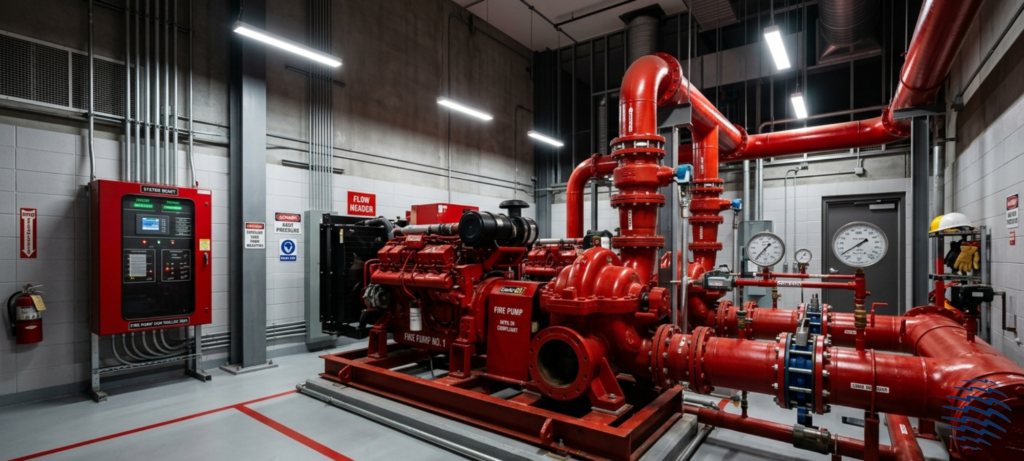
If you’ve ever stood in a mechanical room, you’ve seen it: that massive, often red, beast of a machine sitting quietly in the corner. That fire pump is the single most important insurance policy your building has. But here’s the cold, hard truth—a fire pump that isn’t tested is just a very expensive piece of scrap metal. When the smoke starts rising and the sprinklers need pressure, “hoping” the pump works isn’t a strategy. This is why fire pump testing is the backbone of any serious facility management plan.
In 2026, building codes have become more rigorous, and the technology inside these controllers has grown more complex. Yet, the fundamentals of human-led maintenance remain the same. You need to know your system, you need to hear how it runs, and you need to prove it can handle the pressure.
Why Fire Pump Testing is Your First Line of Defense
A lot of people ask, “Why test a fire pump if it’s never been used?” It’s a fair question, but mechanical systems are actually more prone to failure when they sit idle.
- The Stagnation Problem: Pumps that don’t run can develop “flat spots” on bearings or internal corrosion that you won’t see from the outside.
- Electrical Gremlins: Controllers can have minor board failures or loose connections that only show up when the system tries to pull a heavy load.
- Regulatory Mandates: If you’re wondering, “Are fire alarms and pumps required to be tested annually?” the answer is a definitive yes. NFPA 25 standards make this mandatory to keep your building’s Certificate of Occupancy and your insurance coverage valid.
The Master Schedule: How Often Should Fire Pumps be Tested?
One of the biggest headaches for facility managers is the schedule. It’s easy to miss a date when you’re managing an entire property. However, fire pump testing follows a very specific rhythm that you need to bake into your calendar.
1. The Weekly/Monthly “Churn” Test
This is your routine checkup. If you have a diesel-driven pump, you’re looking at a weekly run because diesel engines need to stay lubricated and their fuel needs to circulate. Electric pumps can usually get away with a monthly fire pump churn test.
2. The Annual Flow Performance Test
This is the “final exam.” Once a year, you have to hook up hoses and prove that the pump can still push its rated Gallons Per Minute (GPM). This is the only way to verify that the internal impellers haven’t worn down over time.
Deep Dive: The Fire Pump Churn Test
Let’s talk about the “churn.” In technical terms, a fire pump churn test means running the pump at its rated speed but with the discharge valves closed. It sounds counterintuitive—why run it if no water is moving?
Well, the churn test tells you three critical things:
- Start Reliability: Does the pump kick on automatically when the pressure drops to the “start” setting?
- Pressure Accuracy: Does the pump hit its “churn pressure” (usually about 10-20% higher than its rated pressure) without struggling?
- Mechanical Health: You get to hear the pump. Is there a weird grinding noise? Is the packing gland leaking too much water? These are things you can only catch during a live run.
For safety officers who are still in training or managing large student campuses, keeping a log of these results is vital. Resources like Student Handout 1.2 offer great templates for documenting these weekly runs to ensure you’re always audit-ready.
Managing the Flow: The Fire Pump Test Header
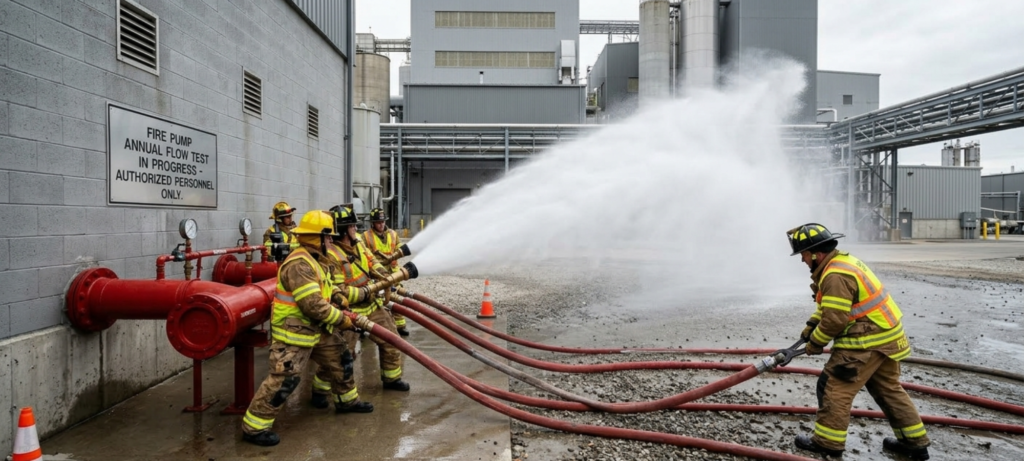
When it’s time for the big annual test, you can’t just let the water swirl inside the pump. You have to discharge it. This is where the fire pump test header comes into play.
The fire pump test header is a manifold, usually found on the outside wall of the pump room or the building’s exterior. It’s equipped with several 2.5-inch hose valves.
During the test, technicians connect heavy-duty fire hoses to this header. The water is then blasted out into a safe area—like a parking lot or a drainage basin—so the team can measure the flow using fire pump testing equipment like pitot tubes or flow meters. This header is the only way to safely move 1,000+ GPM without flooding your own basement.
The Technical Kit: Essential Fire Pump Testing Equipment
You can’t just “eyeball” a flow test. To stay compliant with modern standards, you need a specific set of fire pump testing equipment:
- Calibrated Digital Gauges: These are used to measure the “suction” (what’s coming in from the city) and the “discharge” (what the pump is adding).
- Pitot Tubes and Nozzles: These measure the velocity of the water as it exits the hose.
- Tachometers: Especially for diesel pumps, you need to verify the engine is hitting the correct RPMs.
- Ultrasonic Flow Meters: These are becoming more popular because they allow you to measure flow through the pipes without even needing to attach hoses to the fire pump test header.
Mobile Systems: How to Pump Test a Fire Truck
While most of this guide focuses on stationary building pumps, many industrial sites have their own fire brigades. Learning how to pump test a fire truck is a slightly different animal. Unlike a building pump, a truck pump has to deal with varying intake sources—sometimes a hydrant, sometimes a lake, sometimes its own internal tank.
However, the core metric is the same: the “Pump Curve.” You compare the current test results against the truck’s original “As-Built” curve. If the current performance is more than 5% lower than the original, that truck needs to be pulled from service for a rebuild.
People Also Ask
How often does a fire pump need to be tested for high-rise buildings?
The frequency is the same (weekly/monthly and annually), but the complexity is higher. In high-rises, you often have “booster” pumps on higher floors that must be sequenced correctly to ensure the top floor gets the required pressure.
Why test a fire pump if the building has a modern alarm system?
Think of the alarm as the brain and the pump as the muscle. The brain can tell you there’s a fire, but if the muscle is paralyzed, the building still burns. You test the pump to ensure the “muscle” is ready.
Are fire alarms and pumps required to be tested annually?
Yes, and usually at the same time. Testing them together ensures that the signal from the fire alarm panel actually triggers the pump controller as intended.
Final Thoughts: The Cost of Neglect
At the end of the day, fire pump testing is about moving from “hoping” to “knowing.” It’s an investment in the safety of the people inside your building and the protection of the property itself.
Whether you are a facility veteran or someone just starting out—perhaps even looking for Invisalign Tips for Success or other niche maintenance guides—the lesson is the same: consistency is the only way to avoid failure. Keep your logs crisp, your gauges calibrated, and your pump ready. One day, it might be the only thing standing between a minor accident and a total loss.
You can find us here: Guyana News