
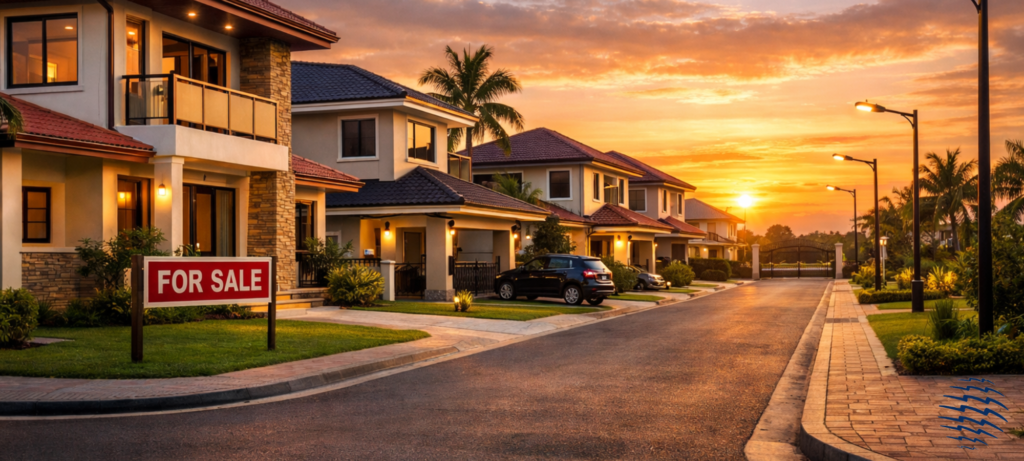
If you’ve spent any time in Georgetown lately, you’ve heard the same buzzwords over and over: “oil,” “boom,” and “opportunity.” But for the average person—whether you’re a local professional or a Guyanese living in Brooklyn or London—the conversation eventually turns to one thing: Guyana houses for sale.
In 2026, the housing market in Guyana isn’t just growing; it’s transforming. With the government’s recent $159.1 billion budget allocation for housing, we are witnessing a tectonic shift from traditional family plots to massive “turnkey” communities and high-tech “smart cities.”
But behind the flashy headlines, what is the ground reality? Is it still affordable? Can you trust the titles? This is a deep dive into everything you need to know about the 592 property market today.
1. The 2026 Market Landscape: A $159 Billion Boost
The 2026 National Budget has signaled a clear direction. Finance Minister Dr. Ashni Singh recently announced a plan to allocate 15,000 new house lots and build 8,000 homes this year alone. This isn’t just about giving out land; it’s about building complete communities with paved roads, concrete interlocking drains, and street lighting.
Why the Shift to “Turnkey”?
For years, the Guyanese way was to get a plot and build slowly over a decade. Today’s young professionals don’t have that kind of time. The government’s shift toward building 8,000 ready-to-move-in homes is a direct response to a 75,000-person backlog. If you are a young professional, the focus is now on modular, faster construction methods that allow you to move in within months, not years.
2. Where to Buy: The Hotspots of 2026
Location in Guyana used to be simple: Georgetown or not Georgetown. In 2026, the new highways have completely changed the map.
The East Bank Corridor: The “Platinum” Belt
Areas like Eccles, Providence, and Republic Gardens are no longer just residential; they are the heart of the “New Georgetown.”
- The Draw: Proximity to the Heroes Highway and the new road links to the East Coast.
- The Value: A 3-bedroom home in a gated community like Republic Gardens can now range from GYD $80M to $150M. These are prime rental assets for the expat community.
The East Coast Revival
With the new four-lane highway, areas like Le Ressouvenir and Chateau Margot are booming. These spots offer a balance—coastal breezes and more land than you’d get in the city, but still only a 20-minute commute to the office.
Silica City: The Future is Inland
If you want to avoid the “coastal squeeze,” Silica City is the play. Located along the Soesdyke-Linden Highway, this project is being built away from the flood-prone coast. It’s Guyana’s first “Smart City,” and buying in early (Phase Two) is seen by many as the best long-term investment.
3. The Price Tags: What You’ll Actually Pay
Property prices in Guyana can feel like a roller coaster. Here is a realistic breakdown of the 2026 market prices:
| Property Type | Location | Estimated Price (GYD) | Status |
| Low-Income Turnkey | Moleson Creek / Wales | $12M – $18M | High Demand |
| Middle-Income 3-Bed | Leonora / Enmore | $25M – $45M | Growing |
| Luxury Executive Home | Bel Air / Prashad Nagar | $180M – $400M+ | Niche |
| Executive Rental | Eccles / Providence | US $3,500 – $6,000/mo | For Expats |
4. Building vs. Buying: The Construction Reality
Many Guyanese still prefer to build their own “castle.” But construction in 2026 comes with a steep learning curve.
Current Construction Costs
Expect to pay between GYD $33,000 and $42,000 per square foot for a mid-range custom home. If you want high-end imported finishes (granite, specialized lighting, smart security), that number can easily climb to GYD $55,000+.
The “Mental Toll” of Building
Building a home is a marathon. Between the Single-Window Permit System (which has thankfully speeded up approvals) and managing contractors, you need stamina. Many owners find themselves overwhelmed by the paperwork and daily site visits. If you’re struggling to stay organized, our guide on Ways to Maintain Focus During Long Tasks is an essential read for anyone embarking on a 12-month build.
5. The Diaspora Connection: Buying from 3,000 Miles Away
If you are in the US, Canada, or the UK, buying back home is emotional. You want that “retirement spot” or a piece of the boom. But the distance is your biggest enemy.
The Risk of the “Friend & Family” Deal
We’ve all heard the horror stories: someone sends $50,000 USD to a relative to build a house, only to find a foundation and an empty bank account two years later. In 2026, you must use Power of Attorney (POA) wisely and hire an independent local lawyer to verify the Transport or Certificate of Title.
Travel Ease
There used to be a fear that strict travel rules would make visiting investments difficult. However, the Guyana US Travel Bond Waiver means you don’t have to worry about that rumored $15,000 bond. You can fly in, handle your business at the Deeds Registry, and fly back without that extra financial burden.
6. Legal Checklists: Don’t Skip These Steps
Guyana’s land system is a mix of Roman-Dutch and English law, which can be confusing.
- Transport vs. Title: Know the difference. A “Transport” is the older system (advertised in the Gazette), while a “Certificate of Title” is the newer, registered system.
- Rates and Taxes: Always get a Compliance Certificate from the GRA and the local N.D.C. (Neighborhood Democratic Council). You don’t want to inherit someone else’s 10-year debt.
- Boundary Surveys: Never buy land without a fresh survey. “Land encroaching” (neighbor building on your land) is one of the most common court battles in Guyana.
7. Is the Real Estate Market a Bubble?
With prices tripling in some areas over the last five years, people are asking: “When will it pop?”
In 2026, the indicators suggest a correction (stabilizing) rather than a pop. The demand for Grade-A office space and expat housing still exceeds the supply. However, if you are buying for rental income, you must be realistic. The market for US$5,000 rentals is smaller than the market for middle-income rentals.
If you are looking for ways to build your down payment, starting a small venture is a great way to bridge the gap. Check out our resources on How to Start a Small Business with Low Budget to help grow your property fund.
FAQ: Your Quick Property Guide
- Can foreigners buy property in Guyana? Yes, though some specific land grants have restrictions. Always consult a lawyer.
- How much is the mortgage rate? In 2026, many banks offer low-income mortgage rates as low as 3.5% to 4%, thanks to government agreements.
- What is the “Single-Window” system? It’s a digital portal that allows you to track building approvals online, reducing the “run-around” at different ministries.
Final Thought
Buying a house in Guyana is more than just a financial transaction; it’s a stake in the country’s transformation. The days of “easy deals” are over, but the era of professional, community-based housing has arrived. Whether you’re looking at a turnkey home in Lethem or an executive villa in Eccles, do your homework, stay focused, and don’t rush the process. Guyana is moving fast, but your property journey should be measured and secure.