
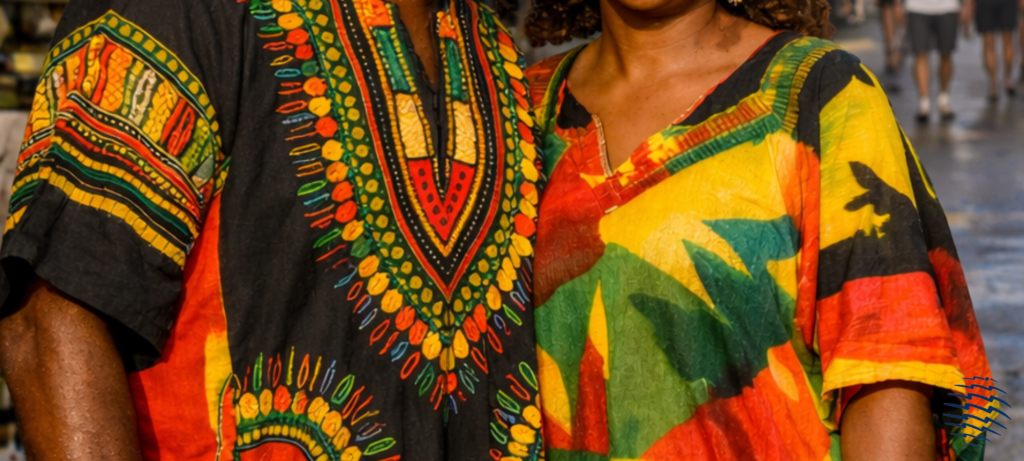
Ask ten Guyanese people what their national dress is and you will get ten different answers. Some will mention the saree their mother wears to Diwali. Some will think of the dashiki their uncle puts on for Emancipation Day. Some will just shrug and say — we do not really have one official outfit.
They are all right. And that is what makes Guyanese clothing genuinely interesting, once you get past the expectation of a simple answer.
Guyana is the only English-speaking country in South America. It is home to six main ethnic communities — Afro-Guyanese, Indo-Guyanese, Amerindian, Chinese, Portuguese, and European — and the clothing traditions of each have been living side by side, borrowing from each other, evolving for centuries. The result is a fashion culture that is layered, diverse, and tied deeply to identity.
This guide covers all of it — traditional attire for each community, everyday clothing, what changes by region, and what to pack if you are visiting.
Table of Contents
- 1. Why Guyana Has No Single National Dress
- 2. Afro-Guyanese Clothing — Culture in Every Thread
- 3. Indo-Guyanese Traditional Dress — Hindu and Muslim Traditions
- 4. Amerindian Clothing — The Original Guyanese Attire
- 5. Chinese-Guyanese and Portuguese Clothing Traditions
- 6. What People Actually Wear Day to Day
- 7. Clothing by Region — Georgetown vs Interior
- 8. Dressing for Guyana’s Climate
- 9. Modern Guyanese Fashion in 2026
- 10. Guyana Clothing — Community Comparison Table
- 11. What Tourists Should Pack for Guyana
- 12. Frequently Asked Questions
- 13. Final Thoughts
1. Why Guyana Has No Single National Dress
Most countries with a strong cultural identity have at least one recognisable national costume. Guyana does not — and understanding why tells you a lot about the country.
Guyana’s population is genuinely multicultural in a way that is unusual even by Caribbean standards. The 2024 census data shows approximately 39% of the population is Indo-Guyanese, 30% Afro-Guyanese, 20% mixed heritage, 10% Amerindian, and smaller communities of Chinese, Portuguese, and European descent. Each of these groups brought distinct clothing traditions, and none of them ever fully replaced the others.
There have been discussions over the years about whether Guyana should designate an official national dress — the way Trinidad has its national costume or Jamaica has its festival dress. So far, no single outfit has been chosen. The argument is always the same: picking one would leave everyone else out.
What exists instead is a rich, multi-layered clothing culture that shifts depending on the occasion, the community, and the part of the country you are in. That is what this guide covers.
2. Afro-Guyanese Clothing — Culture in Every Thread
Afro-Guyanese clothing is most visible and most celebrated during Emancipation Day — August 1st — and at cultural events connected to African heritage. But the tradition runs year-round.
Traditional Afro-Guyanese Attire
For women, the most recognisable traditional garment is the booboo dress — a loose, flowing tunic dress in bold African print fabric, often worn at home, at community gatherings, and at cultural events. The headwrap — a fabric tied around the head in elaborate styles — is equally important. It is not just decoration. The headwrap has a specific history tied to African identity under colonial rule, and wearing it today is a deliberate statement of cultural pride.
For men, the dashiki is the primary traditional garment — a loose, colourful top with embroidered or printed designs, usually worn with matching trousers. Kaftans are also common for men at formal cultural events. Both men and women often wear turbans at significant occasions.
African wax print fabric — also called Ankara — is central to Afro-Guyanese fashion. The bold geometric and floral patterns carry cultural meaning, and matching family sets of the same wax print fabric are commonly worn at Emancipation Day celebrations and family reunions.
When You See This Clothing
Emancipation Day (August 1st) is the main occasion. The National Park in Georgetown fills with families in coordinated wax print outfits. The Hopetown Soirée in Berbice on July 31st is another gathering where traditional Afro-Guyanese dress appears prominently. Weddings, funerals, church gatherings, and community events throughout the year also feature these styles.
| Cultural Note The dashiki and kaftan worn in Guyana today are connected directly to West and Central African clothing traditions brought to the Caribbean through the slave trade. Wearing them on Emancipation Day is explicitly an act of cultural reclamation — not simply fashion. |
3. Indo-Guyanese Traditional Dress — Hindu and Muslim Traditions
Indo-Guyanese communities have maintained strong clothing traditions that trace back to the Indian subcontinent — specifically to the regions of Bihar, Uttar Pradesh, and Tamil Nadu, where most indentured labourers came from between 1838 and 1917. Nearly 180 years later, those traditions are still very much alive in Guyana.
Hindu Indo-Guyanese Attire
Hindu women wear sarees — six to nine yards of fabric draped in specific styles — for religious ceremonies, weddings, and major festivals. Lehengas (long embroidered skirts with a blouse and dupatta) are worn at weddings. The salwar kameez — a tunic top over loose trousers — is more everyday but still traditional. The orhni (a head covering garment) is worn by older Hindu women during worship and formal occasions.
Hindu men wear kurtas (long shirts, usually white or pastel coloured) with loose trousers for daily religious activity. Dhotis — lengths of white cotton fabric wrapped around the lower body — are worn for prayers and ceremonies. For weddings, men wear sherwanis — long formal coats with embroidery, often in cream or ivory.
Muslim Indo-Guyanese Attire
Muslim women in Guyana typically wear the shalwar kameez with a head covering called an orhni or dupatta. For weddings, Muslim brides traditionally wear white or cream lehengas with green and gold detailing — distinct from Hindu brides who often wear red. Abayas are worn by more observant Muslim women in Georgetown and other urban areas.
Muslim men wear the jorah (a two-piece set) and tope (prayer cap) for religious occasions and Eid celebrations.
4. Amerindian Clothing — The Original Guyanese Attire
Guyana’s nine Amerindian peoples — Wai Wai, Macushi, Patamona, Lokono (Arawak), Warao, Akawaio, Arecuna, Carib, and Wapishana — each have their own distinct clothing traditions. These are the oldest clothing cultures in Guyana by a very long margin.
Traditional Amerindian clothing was designed for the tropical environment. Men wore kanji — loincloths made from cotton, tree bark, or tibisiri palm fibre. Women wore apron-style skirts made from similar natural fibres. Both men and women wore elaborate headdresses, beaded necklaces, ear and nose decorations, and leg bands.
The tibisiri palm — a plant found throughout Guyana’s interior — was one of the main weaving materials. Tibisiri baskets, hammocks, and clothing items are still made by some Amerindian communities today, and you can find them at craft markets in Georgetown.
In daily life today, most Amerindian Guyanese wear modern western clothing. Traditional dress appears at village heritage festivals, Amerindian Heritage Month (September), and cultural ceremonies. In the deep interior — particularly in Rupununi communities — traditional elements are more visible in everyday life than in coastal areas.
5. Chinese-Guyanese and Portuguese Clothing Traditions
These two communities are smaller in number but have contributed distinctly to Guyanese culture and clothing.
Chinese-Guyanese
The qipao (also called cheongsam) — a fitted silk dress with a high collar and side slits — is the best-known Chinese-Guyanese traditional garment for women. Tang jackets and traditional silk suits are worn by men for Chinese New Year celebrations and family events. The silk fabrics used traditionally feature floral or dragon motifs in red, gold, and emerald green.
Portuguese-Guyanese
Portuguese settlers left less visible clothing traditions compared to other communities, but their influence shows most in festive dress — embroidered blouses and full skirts that echo traditional Portuguese regional dress. Garlic pork, their main food contribution to Guyana, is arguably better documented than their clothing traditions.
6. What People Actually Wear Day to Day
All of the above is real — and almost none of it appears on a typical Tuesday afternoon in Georgetown.
Everyday Guyanese clothing is overwhelmingly casual and practical. The heat drives everything. Georgetown sits near the equator, temperatures stay between 26°C and 34°C most of the year, and humidity is consistently high. Nobody is wearing a sherwani to the market.
What you actually see most days:
- Cotton t-shirts and shorts — the universal Guyanese daily outfit for men
- Loose dresses and sundresses for women — breathable, practical, widely worn
- Tank tops in coastal areas where heat is most intense
- Lightweight jeans in the evenings or air-conditioned offices
- Simple sandals and sneakers — closed shoes are for occasions
- School uniforms — visible across Georgetown in the mornings
In business settings, men wear light-coloured collared shirts and trousers. Women in offices wear blouses and skirts or lightweight trousers. Full Western office formal — jacket and tie — exists but is rare outside of government settings.
7. Clothing by Region — Georgetown vs Interior
Where you are in Guyana changes what people wear significantly.
Georgetown and the Coast
Modern western clothing dominates. You will see everything from corporate office wear to streetwear to Chinese-made casual fashion that floods markets across the Caribbean. Georgetown has clothing stores, market stalls at Bourda and Stabroek, and increasingly — local designers with their own brands.
Interior Villages and Rupununi
Practical and durable clothing matters more than fashion. The interior is hot, forested, and often muddy. Long-sleeved lightweight clothing for sun and insect protection is more common. In Amerindian communities particularly, traditional elements appear more frequently in daily life than on the coast.
Berbice and Sugar Belt
Indo-Guyanese clothing traditions are particularly strong in Berbice, where the sugar estate communities have maintained Indian heritage for generations. During festivals, the density of traditional attire here is higher than in Georgetown.
8. Dressing for Guyana’s Climate
If you are visiting Guyana, the climate determines your wardrobe more than anything else. Getting this wrong makes the trip genuinely uncomfortable.
- Breathable fabrics only: Cotton and linen. Synthetic fabrics that do not breathe are miserable in Guyana’s humidity.
- Light colours: Dark fabrics absorb heat. Light colours reflect it. Practically everyone in Guyana knows this.
- Rain gear: Guyana has two rainy seasons. When it rains, it rains hard and fast. A light waterproof jacket that folds small is essential.
- Long sleeves for the interior: Sun protection and insect protection both require long sleeves in rainforest areas. Lightweight long-sleeved shirts are ideal.
- Shoes that get wet: Georgetown floods in heavy rain. Closed shoes fill with water. Sandals or quick-dry shoes are smarter for the coast.
- Modest clothing for cultural visits: At temples, mosques, and Amerindian community events, shoulders and knees covered is appropriate and respectful.
| => Pro Tip The single most useful piece of clothing for a Guyana trip is a lightweight long-sleeved shirt in a neutral colour. It works for sun protection, insect protection, modest cultural visits, and cool air-conditioned interiors. Pack three of these and thank yourself later. |
9. Modern Guyanese Fashion in 2026
Something is changing in Guyanese fashion, and it is worth paying attention to.
Guyana’s oil boom — the country is now producing over 600,000 barrels per day from the Stabroek Block — has created a new middle class with disposable income and a growing interest in local identity. That is showing up in fashion.
Young Guyanese designers are building local brands that blend national pride with modern streetwear aesthetics — flag colours in hoodies and joggers, Guyanese proverbs on t-shirts, dashiki-influenced casual tops that work as everyday wear rather than just ceremonial dress. These are not novelty items for tourists. They are being worn by young Guyanese in Georgetown who want clothing that reflects where they are from.
Outside Guyana, the diaspora communities in New York, Toronto, and London have their own fashion ecosystem — Guyanese flag clothing, Independence Day outfits, Caribbean carnival costume. These communities are increasingly connected to what is happening in Georgetown through social media, and that exchange is influencing what gets made and worn on both sides.
Guyana’s cultural calendar drives clothing choices significantly. If you want to understand what people wear and when, our guide to Emancipation Day in Guyana: History, Meaning, Activities & 2026 Date explains the most important cultural event for Afro-Guyanese dress.
10. Guyana Clothing — Community Comparison Table
Here is a quick reference for traditional clothing across Guyana’s main communities:
| Community | Traditional Outfit (Women) | Traditional Outfit (Men) | Worn When | Key Feature |
| Afro-Guyanese | Booboo dress, kaftan, headwrap | Dashiki, kaftan, turban | Emancipation Day, cultural events | Bold African print, bright colours |
| Indo-Guyanese (Hindu) | Saree, lehenga, salwar kameez | Kurta, dhoti, sherwani | Diwali, Navratri, weddings | Embroidered fabric, gold jewellery |
| Indo-Guyanese (Muslim) | Shalwar kameez, orhni veil | Jorah, tope | Eid, weddings, Youman Nabi | White or cream for weddings |
| Amerindian | Plant fibre skirt, beadwork, feathers | Kanji loincloth, headdress | Heritage events, village festivals | Handmade beads, tibisiri fibre |
| Chinese-Guyanese | Qipao/cheongsam, silk dresses | Tang jacket, silk suit | Chinese New Year, cultural events | Floral silk patterns |
| Everyday Guyanese | Cotton dresses, t-shirts, shorts | T-shirts, shorts, casual shirts | Daily wear | Lightweight, heat-appropriate |
One thing worth noting: these categories are not rigid. A Guyanese woman might wear a saree to her Hindu friend’s wedding and wax print fabric to the Emancipation Day celebrations two weeks later. Cultural boundaries in Guyana have always been porous.
11. What Tourists Should Pack for Guyana
Based on everything above, here is a practical packing list:
- 3-4 lightweight cotton t-shirts or tops
- 2-3 pairs of lightweight shorts or thin trousers
- 1-2 lightweight long-sleeved shirts (essential)
- 1 light packable rain jacket
- Sandals or quick-dry shoes for coastal areas
- Closed walking shoes for interior travel
- 1 modest outfit (covered shoulders and knees) for cultural visits
- Sun hat and UV protection
If you are heading to Kaieteur Falls or interior rainforest, clothing requirements are more specific. Our guide on Tours to Kaieteur Falls Guyana (2026): What It’s Really Like to Go covers exactly what to bring for that trip.
Planning a longer stay? Understanding Guyanese food culture is part of understanding the country. Our guide to Guyana Food and Recipes: 15 Traditional Dishes You Need to Try covers the other half of cultural identity.
12. Frequently Asked Questions
| What is Guyana’s traditional clothing? |
| Guyana has no single traditional outfit because of its multicultural population. Afro-Guyanese traditional clothing includes dashikis, booboo dresses, headwraps, and wax print fabric. Indo-Guyanese traditions include sarees, lehengas, salwar kameez, and kurtas. Amerindian dress includes tibisiri fibre garments, beadwork, and headdresses. |
| What is the traditional female dress in Guyana? |
| There is no single traditional female dress — it depends on the community. Afro-Guyanese women wear the booboo dress and headwrap for cultural occasions. Indo-Guyanese Hindu women wear sarees and lehengas for festivals and ceremonies. Indo-Guyanese Muslim women wear shalwar kameez with an orhni. Amerindian women traditionally wear plant fibre skirts with beadwork. |
| What do people wear every day in Guyana? |
| Everyday clothing in Guyana is casual and practical. Cotton t-shirts, shorts, lightweight dresses, and sandals dominate. Georgetown is modern and western in its daily fashion. The hot, humid climate drives clothing choices more than anything else. |
| Does Guyana have a national dress? |
| No official national dress has been designated in Guyana. The multicultural nature of the population makes it difficult to choose one outfit without excluding other communities’ traditions. This has been debated but not resolved. |
| What should tourists wear in Guyana? |
| Lightweight cotton clothing is essential. Pack breathable fabrics, a rain jacket, comfortable shoes, and at least one modest outfit for cultural or religious visits. Long-sleeved lightweight shirts are recommended for interior travel (sun and insects). Avoid heavy fabrics that do not dry quickly. |
| What is Guyanese traditional clothing made of? |
| Traditional garments use various materials depending on community. Afro-Guyanese clothing uses wax print cotton fabric. Indo-Guyanese clothing uses silk, cotton, and embroidered synthetic fabric. Amerindian clothing traditionally uses tibisiri palm fibre, cotton, and natural beads. |
| What is the booboo dress in Guyana? |
| The booboo dress is a loose, colourful tunic-style dress associated with Afro-Guyanese women. It is typically made from bold African print fabric and is worn at home, at community gatherings, and during cultural events like Emancipation Day. The name reflects the relaxed, comfortable nature of the garment. |
13. Final Thoughts
Guyana clothing is not one thing. It never has been.
What you see when you look at how Guyanese people dress is a live record of six cultures that have been sharing the same geography for centuries — borrowing from each other, maintaining distinct traditions, blending where they want to and staying separate where they want to.
The dashiki worn on Emancipation Day and the saree worn for Diwali are both Guyanese clothing. The cotton shorts worn on a hot Georgetown afternoon are just as Guyanese as the tibisiri beadwork made in a Rupununi village.